

Nepal has 16.6 million internet users, a $928 million e-commerce market, and one of the most turbulent platform histories in South Asia. Here’s what every business and marketer actually needs to understand.
Most guides on digital marketing in Nepal tell you the same thing: internet is growing, opportunities are huge, start a Facebook page. That’s not wrong — it’s just incomplete. It doesn’t tell you why the government shut down Facebook for six days in September 2025, why 19 people died before it came back, or what that episode permanently changed about how serious businesses in Nepal think about digital infrastructure.
This guide covers the full picture — what’s working, what the numbers actually say, what happened when the platforms went dark, and what the smartest businesses learned from it.
What is digital marketing?
Digital marketing is the use of online channels — search engines, social media, email, and paid advertising — to attract, convert, and retain customers. Unlike a billboard or a newspaper ad, every digital channel produces data: who saw your message, who clicked, who bought, and what it cost per conversion.
That’s the technical definition. The more useful definition for a Nepali business in 2026 is this: digital marketing is how customers find and evaluate you before they ever contact you. Someone looking for a cosmetic clinic in Kathmandu searches Google, scrolls Facebook, reads reviews, and looks at Instagram — all before making a call. The business that shows up consistently at each of those touchpoints wins the customer before the conversation starts.
The businesses that treat digital marketing as “posting regularly” are not competing with businesses that treat it as a customer acquisition system. They’re in different categories entirely.
The state of digital Nepal in 2026
The numbers are real and the growth is genuine. But the headline figures require context that most articles skip.
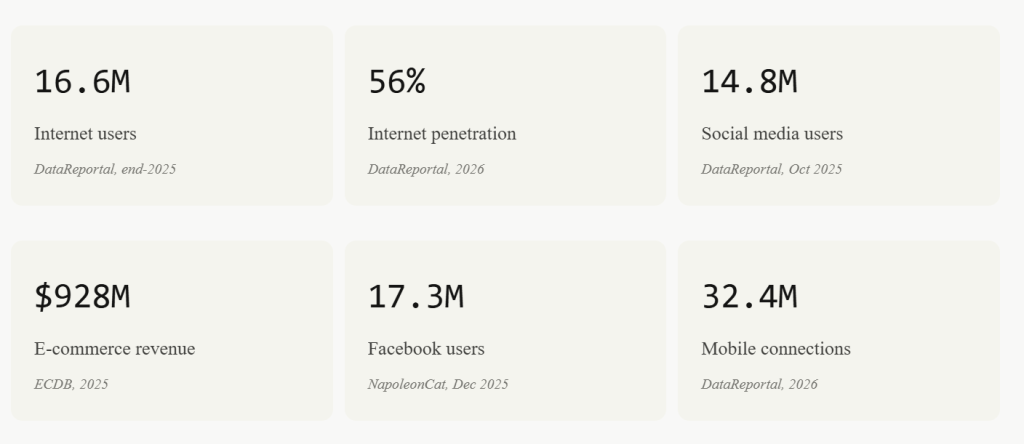
What the numbers don’t show: 77% of Nepal’s population still lives in rural areas (DataReportal, 2026), where internet access is mobile-dependent and intermittent. The digital marketing opportunity is real — but it’s concentrated. Most active online consumers and buying-intent traffic live in Kathmandu Valley, Pokhara, and a handful of secondary cities. Campaigns targeting “all of Nepal” are frequently targeting a much narrower effective audience than the headline figures suggest.
Traditional marketing vs digital marketing
The comparison matters less than most guides suggest. The relevant question for a Nepali business in 2026 is not “traditional or digital” — it’s “what does each channel actually do, and which stage of the customer journey does it serve?”
Traditional
- Builds mass awareness at scale
- High emotional impact
- No measurable conversion data
- Expensive entry for small businesses
- Effective for established brands
Digital
- Measurable cost per lead and sale
- Precision audience targeting
- Adjustable mid-campaign
- Accessible at small budgets
- Two-way customer communication
The businesses growing fastest in Nepal right now are not using only digital — they’re using digital to handle what digital does well (targeting, measurement, conversion) and traditional to handle what traditional does well (brand awareness, trust signals, reach into offline communities). Treating them as rivals is a false choice most marketing guides still push.
The real benefits of digital marketing in Nepal
Nepal’s advertising industry was estimated at approximately $150 million as of 2025, growing at roughly 12.7% annually through 2026, according to Infinity Digital Agency’s industry analysis. Digital’s share of that is rising.
But the standard list of benefits — cost-effective, measurable, global reach — misses the mechanism that makes digital marketing genuinely powerful in Nepal’s specific context.
The benefit isn’t that digital marketing is cheap. It’s that it’s the first marketing channel in Nepal’s history where a small business can outperform a large one based on strategy rather than budget.
A Kathmandu clinic with a well-structured Google Ads campaign and a strong landing page will beat a larger competitor with a bigger budget but worse conversion architecture — because digital rewards relevance and intent-matching, not just spend. That structural advantage didn’t exist in traditional advertising.
The second real benefit: compounding. A Facebook ad stops when you stop paying. An SEO article that ranks on Google’s first page keeps bringing visitors for years. An email list keeps working. Businesses that understand the difference between rented attention (paid social) and owned assets (search rankings, email lists, YouTube channels) build compounding advantages. Businesses that only rent attention stay on a treadmill.
What happened in September 2025 — and what it permanently changed
On September 4, 2025, Nepal’s government banned 26 social media platforms — including Facebook, Instagram, WhatsApp, and YouTube — for failing to register under the Social Media Act 2081. The ban lasted six days. On September 9, after 19 people were killed and more than 400 injured in Gen Z-led protests across the country, Prime Minister KP Sharma Oli resigned and the Cabinet reversed the ban. Kathmandu Post confirmed the reversal that evening.
By September 10, all platforms were operational again. The crisis was over. But what it revealed is permanent.
The platform dependency lesson
Businesses built entirely on Facebook and Instagram for lead generation lost six days of revenue with zero warning. Businesses with Google search rankings, email lists, and owned website traffic lost nothing. The September 2025 episode is the most clarifying case study on digital asset ownership Nepal has ever produced — and most businesses haven’t updated their strategy based on it.
The broader regulatory context: Nepal previously banned TikTok in November 2023 before lifting it in August 2024. Telegram was banned in July 2025. The Social Media Act 2081’s registration requirements for platforms haven’t gone away — they’ve been suspended, not repealed. As of mid-2026, Facebook, Instagram, YouTube, and other platforms are fully operational. But the regulatory framework that enabled the ban remains in law.
What this means practically: platform diversification is no longer optional for serious businesses. SEO, email marketing, and YouTube — channels businesses control or own long-term — are now strategic necessities, not nice-to-haves.
Major digital marketing channels in Nepal
1. Social media marketing
Facebook is the dominant platform in Nepal by a significant margin. With 17.3 million users as of December 2025 (NapoleonCat), representing 53.7% of the population, it remains the primary channel for most Nepali businesses running paid social campaigns. The 25–34 age group is the largest segment, at 6.1 million users, and men outnumber women 56% to 44% on the platform.
| Platform | Users (Nepal) | Primary strength | Best for |
|---|---|---|---|
| 17.3M | Broadest reach, paid ads | All business types, lead gen | |
| Messenger | 15.8M | Direct customer communication | Follow-up, support, DM commerce |
| 4.7M | Visual content, younger audience | Fashion, food, cosmetics, lifestyle | |
| TikTok | 2.2M+ | Organic reach, 3–5× Facebook engagement | Youth brands, discovery, content |
| YouTube | Growing fast | Search-driven video, long-term content | Education, tutorials, authority |
| 2.3M | Professional network, B2B | B2B services, hiring, thought leadership |
Sources: NapoleonCat Dec 2025, DataReportal 2026, Wikipedia TikTok ban Nepal
One performance reality most guides skip: organic reach on Facebook business pages in Nepal has dropped below 5% — meaning fewer than 1 in 20 followers see any given post without paid promotion. Businesses expecting organic Facebook posts to drive growth in 2026 are operating on 2019 assumptions.
Social commerce — where discovery, evaluation, and purchase all happen within a platform — is growing rapidly. Many small Nepali businesses now run their entire operation through Facebook and Instagram DMs, with payment via eSewa or Khalti. This creates reach without a website, but it also creates total platform dependency.
2. Website and SEO
A website is the only digital asset a Nepali business fully owns. Social media accounts are owned by platforms. Search rankings, while not guaranteed, are built on a website you control. Email lists belong to you. This distinction has moved from philosophical to operational since September 2025.
SEO in Nepal in 2026 is not the same discipline it was three years ago. Google’s search quality updates — particularly the 2024 Helpful Content Update and subsequent core updates — have significantly reduced the ranking potential of AI-generated or generic content. The articles flooding Nepali search results that simply repackage information available elsewhere are increasingly ranking below content that demonstrates real operational experience.
For Nepali businesses, this means that content written by someone who has actually run campaigns, managed clients, or operated in the relevant industry outranks content written to a keyword brief by someone who hasn’t. The bar for SEO content in Nepal’s competitive verticals has risen considerably, and most competitors haven’t adjusted.
Mobile-first is not a suggestion. Over 90% of Nepal’s internet access is via mobile (DataReportal, 2026). A website that doesn’t load fast on a 4G connection is, for the majority of Nepali users, a website that doesn’t work.
3. Google Ads
Google Ads remains underutilised in Nepal relative to its actual value — and this gap is the most significant overlooked opportunity in Nepali digital marketing.
Here’s the mechanism that matters: when someone searches “best dental clinic Kathmandu” or “study abroad consultancy Nepal fees,” they have already decided they need the service. They’re selecting a provider. Facebook Ads interrupt someone who wasn’t thinking about your service. Google Ads intercept someone who’s actively trying to choose one. The conversion rate difference between these two intent states is significant — and most Nepali businesses aren’t competing on Google Search because they’re pouring everything into Facebook.
The practical implication: if you operate in a category where customers search for providers — clinics, consultancies, agencies, travel companies, real estate, education — Google Ads is almost certainly underweighted in your marketing mix relative to the intent value it captures.
4. Content marketing
Content marketing is misunderstood in Nepal in a specific way: most businesses think of it as social media content — posts, reels, stories. That’s one distribution channel for content. The content that compounds is different: articles that rank on Google and keep attracting readers for years; YouTube videos that answer specific questions and build subscriber bases; email newsletters that nurture leads over months before they convert.
GadgetByte Nepal is the clearest local proof of this model. Their content — YouTube reviews, blog comparisons, social media posts — has built an audience that trusts their recommendations enough to follow them to purchase. That trust converts differently than an ad. An ad creates interruption. Years of useful content creates authority that survives ad fatigue entirely.
The challenge: content marketing is slow in its early phase and fast in its compounding phase. Most businesses give up during the slow phase before reaching the compounding phase. The businesses that are dominating Nepali search results for their categories today started building content assets two or three years ago.
5. Influencer marketing
The influencer marketing dynamic in Nepal has shifted. Follower count is no longer a reliable proxy for campaign value. A creator with 20,000 highly engaged followers in a specific niche — fitness, finance, food, travel — regularly outperforms pages with 500,000 followers and minimal authentic engagement.
The measurement problem that persists: most influencer campaigns in Nepal are still evaluated on reach, views, and likes — not on leads generated or sales attributed. Until businesses start tracking conversion from influencer content (using unique discount codes, link tracking, or landing pages), they’re spending on a channel they can’t actually measure.
TikTok’s role is worth noting specifically. A 2025 SSRN study by Syrus Rajbhandari documented the direct economic impact of TikTok’s 2023 ban and reinstatement in Nepal — showing measurable declines in revenue and reach for brands during the ban, with sharp recovery after reinstatement. TikTok’s algorithm also gives smaller accounts disproportionate reach compared to Facebook’s, where ad spend largely determines visibility.
A framework for thinking about digital marketing in Nepal
After the September 2025 episode, the distinction that matters most for Nepali businesses is not which platform to use — it’s what type of digital asset they’re building. Here is a framework for categorising that:
The Nepali Digital Asset Framework — 2026
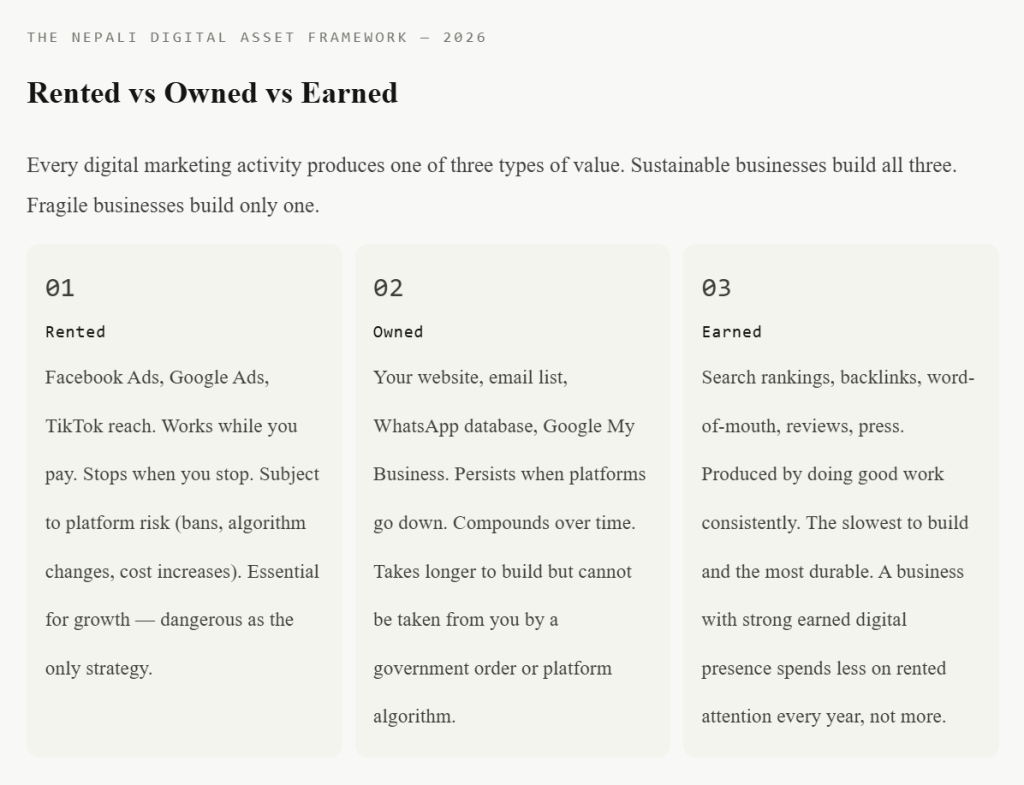
Most Nepali businesses over-invest in Rented and under-invest in Owned and Earned. The businesses that emerged from September 2025 with the least disruption were those with strong Owned and Earned assets — their leads kept coming through Google, their email subscribers kept reading, their YouTube subscribers kept watching.
Digital marketing trends shaping Nepal in 2026
E-commerce as a marketing battleground
Nepal’s e-commerce market generated $928 million in 2025 (ECDB), with Daraz remaining the dominant platform. But the more significant trend is what’s happening below the Daraz layer: social commerce, where businesses sell directly through Facebook and Instagram without a separate e-commerce site, is growing quickly among small Nepali businesses. This model — discovery to purchase within a social platform, payment via eSewa or Khalti — has dramatically lowered the barrier to entry for online selling.
The payment infrastructure that enables this matters: eSewa, Khalti, Fonepay, and ConnectIPS are now widely integrated across platforms. Cash on delivery still dominates formal e-commerce at roughly 80% of transactions (Infinity Digital Agency), but digital wallet usage among younger consumers is growing. For businesses marketing to the 18–34 demographic, digital payment integration is a conversion requirement, not a bonus feature.
Short-form video as primary discovery
TikTok in Nepal delivers 3–5 times higher engagement rates than Facebook for content reaching younger demographics, according to Kokil Thapa’s 2026 social media analysis. The mechanism matters: TikTok’s algorithm distributes content based on engagement signals, not follower count. A business with zero followers can reach 100,000 people with one video if it performs. Facebook’s algorithm, by contrast, heavily favours accounts that pay for distribution.
This means short-form video is the equaliser channel in Nepal’s digital marketing landscape — the one place where small businesses can compete with established ones purely on content quality. The businesses that haven’t developed short-form video production capability are increasingly invisible to the 18–34 demographic.
AI content saturation and the originality premium
AI tools have made it cheap and fast to produce average content. The consequence for Nepal’s digital marketing landscape: generic blogs, generic ad copy, and generic social posts are everywhere. Google’s evolving search quality systems increasingly reward content that demonstrates first-hand experience and genuine expertise — what Google calls E-E-A-T (Experience, Expertise, Authoritativeness, Trustworthiness). Articles written from real operational knowledge now rank above AI-assembled summaries in most competitive categories.
For Nepali businesses, this is an opportunity. Most local competitors are producing generic content. A business that publishes real campaign results, actual client data, and genuine market insight has a significant SEO advantage precisely because the bar around it has dropped.
Performance marketing replacing presence marketing
The shift from “we need to be on Facebook” to “what is our cost per lead from Facebook” is happening across Nepali businesses of all sizes. Job portals like Merojob and KumariJob consistently list 50–70 active digital marketing vacancies, with growing demand specifically for performance marketers — people who manage paid campaigns, read analytics, and can speak in cost-per-acquisition terms rather than follower counts (KumariJob, 2026).
How to implement digital marketing in Nepal
Step 1: Research before execution
The most common cause of failed digital marketing in Nepal is starting with execution before understanding the market. Research means: who specifically is your customer, where do they spend time online, what are they searching for, what are competitors doing well, and what gaps exist that you can fill. This step is skippable — and most businesses skip it. Campaigns built without this foundation are expensive guesses.
Step 2: Build a strategy with defined metrics
A strategy is not a posting schedule or a content calendar. A strategy defines the business outcome you’re trying to achieve, the specific metrics that tell you if you’re achieving it, which channels serve your specific audience’s behaviour, and what you will stop doing if the data shows it isn’t working. Most “digital marketing strategies” in Nepal are content plans without business logic attached to them.
Step 3: Build owned assets in parallel with paid campaigns
The trap: paid campaigns produce fast results and create an addiction to rented attention. Businesses that run Facebook Ads for two years without also building a website, an email list, and search rankings have paid rent for two years and own nothing. The sustainable model runs paid campaigns for fast results while simultaneously building owned assets that reduce the long-term cost of customer acquisition.
Step 4: Focus on the highest-intent channel for your category
Not every channel fits every business. A B2B consultancy in Kathmandu will find LinkedIn and Google Search more valuable than TikTok. A fashion brand targeting 18–24 year olds will find TikTok and Instagram Reels more valuable than LinkedIn. Channel selection should follow where your specific customer is in an active consideration mindset — not where the largest total audience exists.
How to learn digital marketing in Nepal
The learning resources exist. The problem is the gap between consuming information and building real execution capability. Every year, thousands of Nepalis complete digital marketing courses and cannot run a profitable campaign because they’ve never had to make decisions with real money, real clients, and real consequences.
The paths that actually build capability: running your own campaigns with real budget, however small; working at an agency where you manage real client accounts; building your own content property and practicing SEO on it; doing internships where the agency handles real campaigns rather than training exercises. Passive consumption of marketing content produces people who can discuss digital marketing intelligently. Active campaign management produces people who can do it.
The salary data reflects this gap. According to KumariJob’s 2026 salary guide, average digital marketing roles pay NPR 30,000–60,000 per month. But roles with demonstrable performance results — campaigns with trackable ROI, not just content creation — command NPR 80,000–150,000+. The difference is entirely in execution evidence.
Career and earnings in digital marketing in Nepal
| Role | Entry (NPR/mo) | Experienced (NPR/mo) | What drives the ceiling |
|---|---|---|---|
| SEO specialist | 20,000–30,000 | 80,000–120,000+ | Technical depth, international clients |
| Social media manager | 20,000–30,000 | 60,000–100,000 | Paid ads capability, analytics |
| PPC / performance marketer | 25,000–35,000 | 80,000–150,000+ | Proven ROAS, conversion data |
| Content marketer | 18,000–25,000 | 40,000–70,000 | SEO integration, strategy ownership |
| Digital marketing manager | — | 70,000–150,000+ | Full-funnel ownership, team results |
| Freelancer (international clients) | Varies | 100,000–300,000+ | Specialisation + global pricing |
Sources: KumariJob 2026 salary guide · SkillShikshya 2026 salary report · Glassdoor Kathmandu data
The income multiplier that no local salary guide discusses directly: serving international clients. A performance marketer in Kathmandu who serves Australian, UK, or US clients bills at international market rates — typically 4–8× the equivalent Nepali rate. Nepal’s cost of living arbitrage makes this the highest-return career move available to someone with strong performance marketing skills, and it’s increasingly accessible as remote work infrastructure matures.
The future of digital marketing in Nepal
Three forces will define the next three years.
First: the regulatory environment around social media will continue evolving. The Social Media Act 2081’s registration requirements haven’t been repealed — they’ve been deferred. As more platforms comply (TikTok’s compliance model set the precedent), the regulatory relationship between Nepal’s government and global platforms will stabilise. But the September 2025 episode has already permanently changed how sophisticated businesses think about platform dependency.
Second: e-commerce will continue absorbing marketing budget. Nepal’s e-commerce market is projected to grow 7–10% annually through 2030 (ECDB), reaching approximately $1.95 billion. Every rupee of that growth is a rupee being allocated to digital rather than offline channels. The businesses building digital acquisition infrastructure now — search rankings, retargeting, email lists — are positioning for that compounding demand.
Third: the performance accountability gap will become a hiring and competitive divide. As the tools for measuring digital marketing ROI become standard, businesses that can’t measure what their marketing produces will lose ground to those that can. The demand for people who can demonstrate measurable impact — not just activity — will increase faster than the supply of people who can actually do it.
Digital marketing in Nepal is no longer a question of whether to participate. It’s a question of whether you’re building assets that compound or renting attention that evaporates.
Frequently asked questions
What is digital marketing and why does it matter for Nepali businesses specifically?
Digital marketing is the use of online channels to attract and convert customers. In Nepal’s specific context, it matters because 16.6 million people are online (DataReportal, 2026), most of them on mobile, and most purchasing decisions now involve online research before contact. A business that isn’t findable online in 2026 is losing consideration before the conversation starts.
Are Facebook and Instagram available in Nepal in 2026?
Yes. After a six-day ban in September 2025 — which ended following protests that killed 19 people and led to the resignation of Prime Minister KP Sharma Oli — both platforms were restored and are fully operational as of mid-2026. The regulatory framework that enabled the ban (Social Media Act 2081) remains in law, but all major platforms are currently accessible and running ads normally.
What are the most important digital marketing channels for a Nepali business in 2026?
It depends on what your customers are doing. For businesses where customers actively search for providers — clinics, agencies, consultancies, schools — Google Search and SEO are the highest-intent channels. For businesses marketing to younger consumers — fashion, food, entertainment — TikTok and Instagram Reels offer the best organic reach. Facebook remains the broadest paid advertising platform. YouTube builds the most durable long-term audience. Email and WhatsApp are the most reliable retention channels.
How much does a digital marketer earn in Nepal in 2026?
Entry-level roles: NPR 20,000–35,000 per month. Mid-level with 2–3 years of proven results: NPR 60,000–100,000. Senior specialists and managers: NPR 80,000–150,000+. Freelancers serving international clients: NPR 100,000–300,000+ depending on specialisation. The jump from entry to senior is driven almost entirely by demonstrated campaign performance, not years of experience or certifications. (Sources: KumariJob 2026, SkillShikshya 2026)
What is the biggest mistake businesses make in digital marketing in Nepal?
Building all of their customer acquisition on rented platform audiences — Facebook pages and paid social — without building any owned assets (website, email list, search rankings). The September 2025 platform ban was a six-day demonstration of what that dependency costs. Businesses with diversified digital infrastructure — particularly those with SEO traffic and email lists — lost nothing. Businesses with Facebook-only strategies lost a week of leads with no warning.
What is the scope of digital marketing as a career in Nepal?
Demand is real and growing. Job portals like KumariJob and Merojob consistently list 50–70 active digital marketing vacancies at any given time (KumariJob, 2026). The biggest opportunity is at the mid-to-senior level, where demand exceeds supply — particularly for performance marketers who can manage paid campaigns and demonstrate measurable ROI rather than generalist social media managers who can create content. The international freelance market is an additional income ceiling that most local salary guides don’t account for.